
USA-Bound: Best Replica Watches Ready for Direct Delivery
HomeWhat I Learned Buying a 4130 Daytona Replica: Movement Tiers, Factory Reality, and the $1,200 Decision
I have bought four Daytona replicas in three years. Two were mistakes, one was acceptable, and one I still wear weekly. The difference between the acceptable one and the one I still wear was not the dial color, the bezel engraving, or how the bracelet felt on day one. It was whether the watch had a real 4130 clone inside or a dressed-up substitute that looked correct for six weeks and then started losing time, sticking pushers, or both. This is not a review of one watch. It is a record of what I wish someone had told me before I spent money on the first three, written for people comparing replica watches who want a decision they will not regret in a year. Every cosmetic detail matters, from the ceramic bezel to the 904L case to bracelet articulation. It just matters second.
The 4130 Clone Is Not One Thing, and That Is the First Thing Buyers Get Wrong
When a listing says “4130 movement,” it can mean at least three different things. It can mean a full clone of the Rolex calibre 4130 produced in the Dandong operation, with a column wheel, a vertical clutch, and the correct 3-6-9 sub-dial layout. It can mean a genuine 4130 clone with factory-specific differences in finishing, regulation hardware, or bridge decoration. Or it can mean a seller using “4130” as shorthand for a chronograph that fits inside a Daytona case, which sometimes turns out to be a modified 7750 or a modular build that was never a 4130 at all.
In my experience the confusion exists because the same base calibre shows up at wildly different prices depending on the case, dial, and bracelet built around it. A Dandong 4130 in a top-tier case is a different buying decision from the same Dandong 4130 in a thin case with a flat dial and a bracelet that rattles. The movement is identical; the ownership experience is not. The 4130 clone itself has proven genuinely stable when it is the real article. From what I have seen across owner reports and my own watches, a healthy unit holds within roughly five seconds a day under normal wear, and the chronograph starts and resets with the mechanical snap you expect from a column-wheel design rather than the soft delay of a module.
The practical consequence is that price differences should be read as movement questions first. If two listings are $300 apart, the first question is not what is wrong with the cheaper one. It is which 4130 is in each. A seller who cannot confirm the calibre, show a case-back photo, or describe the balance-cock shape is answering the question by refusing to answer it.
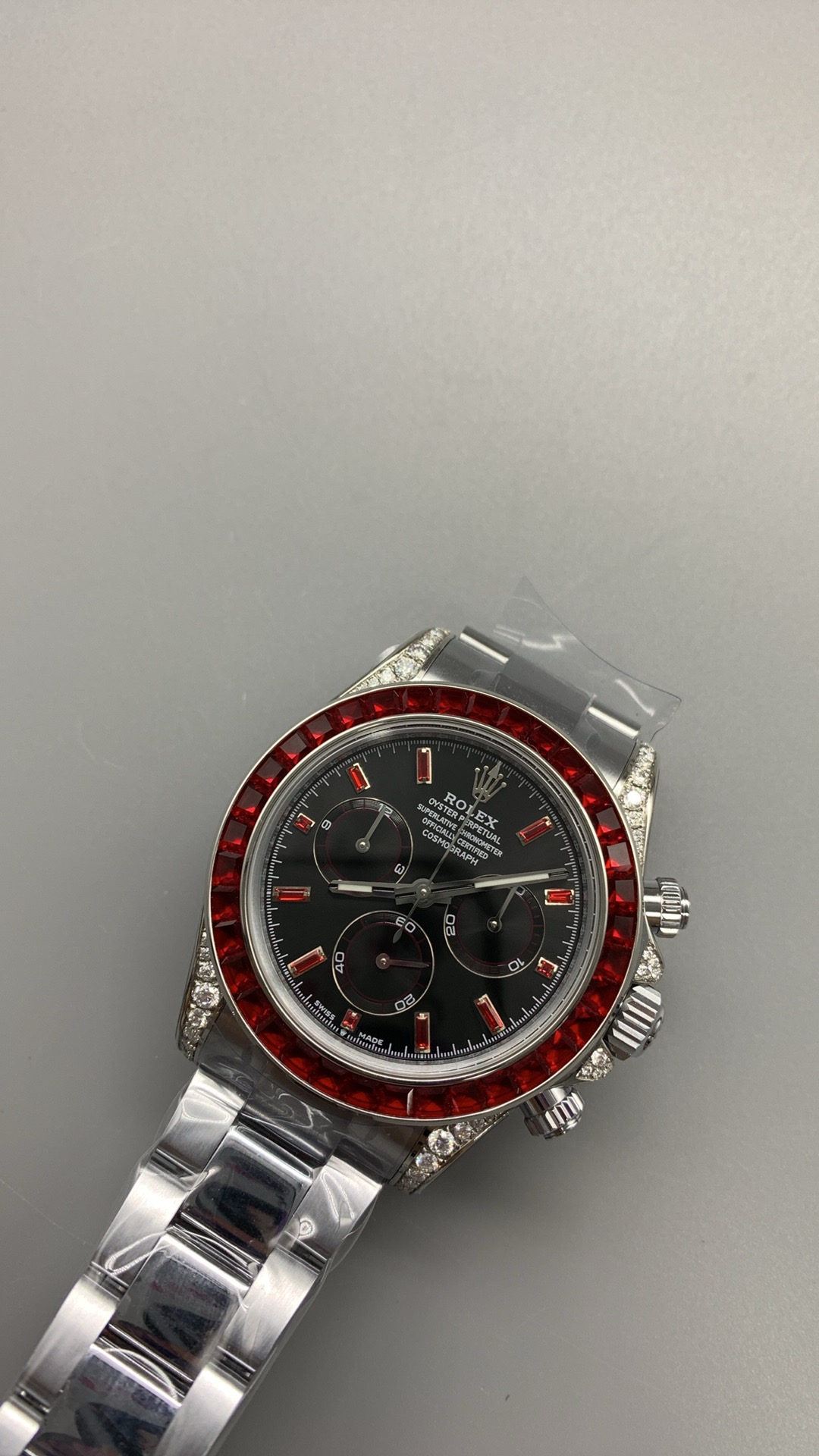
What a Full Clone Actually Means Structurally
A genuine 4130 clone is a purpose-built chronograph calibre, not a base movement with something bolted on top. That distinction shows up in three places. The first is the column wheel and vertical clutch arrangement, which is what gives the pushers their crisp start and reset sequence. The second is the bridge layout and balance-cock geometry, which mirror the genuine 4130 closely enough that a watchmaker familiar with the real calibre can work without reverse-engineering a hybrid system. The third is the jewel count and finishing standard, which on a proper clone reaches 44 jewels with regulated finishing rather than decorative plates.
Structural similarity matters because it determines how the watch ages. A direct-drive chronograph wears its load across one integrated system, so pusher feel stays consistent and reset remains decisive. A modular design stacks a chronograph mechanism on top of a base movement, which introduces additional friction paths and more places for the reset to lose its snap. That is the reason a cloned 4130 can be serviced while a modular chronograph is often cheaper to replace than repair. The takeaway is simple: structural similarity is not a luxury detail. It is the difference between a watch with a maintenance path and a watch without one.
Why the Same Movement Feels Different in Different Cases
The calibre sets the floor of the experience, not the ceiling. Two watches with identical Dandong 4130 movements can feel like different products because of case thickness, dial flatness, bracelet articulation, and how well the movement was regulated before shipping. A correctly proportioned case lets the watch sit the way a Daytona should; a thin or over-thick case changes how the pushers feel in the hand even though the mechanism is unchanged.
From what I have seen, regulation is where budget builds cut corners most quietly. A 4130 clone that leaves the factory at plus twelve seconds a day is still a good movement, but nobody regulated it. A watchmaker can bring that down to within a few seconds for a modest fee, and that single step often does more for daily satisfaction than any cosmetic upgrade. The implication for buyers is that the movement decision should be made first and the case decision second, and that a small regulation budget should be treated as part of the purchase price rather than an afterthought.
Three Movement Tiers and Three Different Ownership Outcomes
The useful comparison is not 4130 versus everything else in the abstract. It is three specific tiers with three different risk profiles: the 4130 clone, the newer 4131 clone, and the 7750 or modular builds that occupy the lower end. Each makes sense for a different buyer, and each fails in a predictable way. Knowing the failure mode in advance is what separates a considered purchase from an expensive lesson, which is why experienced buyers of replica watches tend to ask about the calibre before they ask about the dial color.
The 4130 Clone: The Known Quantity
The 4130 clone is a full cloned chronograph calibre with a rated 72-hour power reserve. In practice I would plan on 60 to 65 hours of usable reserve rather than the full figure, because the final hours of any power reserve run at reduced amplitude and the rate at hour 68 is never the rate at hour 8. That is normal mechanical behavior rather than a clone-specific defect, and anyone quoting the full 72 hours as a daily-wear expectation is overselling the spec.
Service is the real advantage. A proper clean and lubrication for a cloned chronograph typically runs $75 to $175 plus parts depending on market, which is meaningful money but far below the cost of replacing a watch. Stability has been the strongest part of my experience: the unit I wear most has run for over two years without service and still keeps within roughly five seconds a day. The caveat is batch variance, which is why a regulation check on arrival is worth more than any pre-purchase photograph.
The 4131 Clone: Period Matching Over Spec Sheets
The 4131 clone appears in current-reference Daytona replicas and adds refinements that matter more under magnification than on the wrist: different shock-absorber geometry, slightly revised finishing, and a bridge layout that follows the latest genuine references more closely. In daily use the gap between a good 4131 and a good 4130 is smaller than forum discussion suggests. Both keep time in the same window and both operate the chronograph correctly.
The decision should be driven by the reference, not the spec sheet. For a 126500-series build, the 4131 is the period-correct calibre and the small premium is coherent. For a 116500-series build, the 4130 is correct and there is no wearing advantage to paying more for the newer number. What actually determines satisfaction is the condition of the specific movement in front of you, since a well-regulated 4130 will outperform a poorly assembled 4131 every time.
The 7750 and Modular Tier: Where Regret Lives
This is the tier that produces most of the disappointment I have seen, and it is also where the most common buying mistake hides. A 7750-based chronograph is a workhorse calibre, but inside a Daytona case it creates two problems that no amount of cosmetic work can fix. The sub-dial layout and calendar mechanism are not native to the Daytona architecture, so the watch often has a phantom date position or registers that do not behave the way they should. The pusher feel and reset action are noticeably softer than a column-wheel design.
One common mistake is assuming that a “modified Swiss-style chronograph” is close enough because it looks right through the case-back and photographs well. The failure mode is rarely immediate. The watch works for a month, then the chronograph seconds hand hesitates on start, or the reset stops snapping cleanly back to twelve. That hesitation is the compromise announcing itself, and it usually arrives just after the return window closes. If you intend to use the chronograph at all, and on a Daytona the pushers are part of the point, this tier is not a shortcut. It is a different product wearing the same clothes.
Factory Reality: Clean Is Not the Default Answer Anymore
The factory conversation changed in 2025, and a lot of buying advice has not caught up. Clean Factory was the default answer for years because its VR4130 was a full cloned chronograph calibre and its case and dial work set the benchmark for the 116500 generation. Then reports of a raid in July 2025 changed the supply picture, and community rankings subsequently moved VSF, QF, and BTF into the top slots for the steel Daytona, with Clean increasingly discussed in terms of remaining stock rather than active production. Anyone still treating the best replica watches as a fixed list of brand names is working from outdated information.
This matters because the factory question is a supply-chain question, not a permanent verdict. It shifts with raids, batch quality, and which operation is currently putting its best parts into which reference. For a 116500 buyer in 2026 the practical comparison is VSF against BTF, with QF as a third option depending on whether the free-sprung movement matters and whether the current dial batch is good. VSF has ranked first in community guides for much of 2026, but owner reports are not unanimous: some Panda dials have been described as too pale, and at least one owner returned a VSF 126500 in favor of BTF because the pushers looked long. BTF has its own advocates on case shape and pusher proportion, and the choice often comes down to which flaw you find less irritating rather than which factory is objectively better.
Clean Versus AR: Why Movement Architecture Decides
The comparison that actually teaches something is Clean against AR, because it shows why architecture outranks marketing. Clean’s Daytona runs a full cloned VR4130. AR’s Daytona runs a cloned 3135 base with a chronograph module stacked on top. Both can be described as super clone tier. Both use 904L steel. Both can pass a casual glance through a case-back from someone who is not reading movement architecture.
The difference is that Clean’s approach is a purpose-built chronograph calibre and AR’s is a workaround. If the price gap between the two is a few hundred dollars, that gap is not a premium for a name. It is the cost of the right movement, and it changes the service story, because the watchmaker is dealing with one integrated system rather than two stacked ones. A modular chronograph can be reliable, and some owners are perfectly happy with them, but it is not the same ownership proposition. The correct reading of this comparison is that the case, dial, and bracelet are interchangeable variables while the movement architecture is the fixed decision underneath them.
The Batch Problem Nobody Prices In
The second mistake is buying a factory name without buying a batch. Clean’s remaining stock is not automatically better than a current VSF or BTF just because the Clean name carries history. A Clean case with a substituted movement, or a “Clean-style” build assembled from mixed parts, is a real risk in the secondary market, and it is one that photographs cannot resolve. The question worth asking is not whether a watch is Clean, but whether it is a complete build with the DD4130 inside, and whether the seller can demonstrate that on request.
From what I have seen, sellers who answer movement questions in specific terms tend to be consistent across other details too, because the same discipline that produces a clear answer about a calibre usually produces a clear answer about shipping and condition. Sellers who deflect the movement question tend to be vague about everything else. That pattern has held across every transaction I have been part of, and it is a more reliable filter than any ranking list.
The Wrist Test vs the Macro Test
Most buyers decide using what I call the Macro Test. They compare close-up photographs of dial printing, rehaut engraving, bezel font thickness, and movement finishing. That is the right method if you plan to photograph the watch, inspect it under magnification, or hand it to someone who will. It is the wrong method if you plan to wear it.
The Wrist Test is different. At arm’s length, under restaurant lighting, across a meeting table, nobody is measuring the height of the text on the dial. What registers is whether the watch keeps time, whether the bracelet articulates without pulling hair, whether the pushers return with a clean click, and whether the case sits the way you expect. The 4130 clone passes the Wrist Test far more decisively than it passes the Macro Test. It keeps time within a few seconds a day, it operates correctly, and it does not announce itself as a compromise when you press the top pusher. Under a macro lens next to a genuine 4130 you will find differences in finishing, regulation hardware, and engraving depth, because that is what a clone is.
The consequence is that buyers who spend weeks comparing close-up shots and then save money on the calibre are optimizing for the test they run once and ignoring the test they run daily. The better sequence is to set a movement floor first, then compare cases and dials within that floor. This is also why the whole category of fake watches deserves to be judged on function rather than photography. A watch that looks correct in a picture and stumbles on the wrist is a worse purchase than one with a slightly softer dial print that runs cleanly for two years.
What $1,200 Buys, and What It Does Not
The super clone tier in 2026 sits roughly between $1,000 and $1,300 for a working-chronograph Daytona, with dealer pricing around $964 to $1,187 for top factories depending on reference and availability. That is the band where the 4130 clone is standard rather than aspirational. Below it you are either in an honest middle ground where the chronograph is partly decorative, or in the costume tier where the layout is wrong and the movement is an afterthought.
What the money buys is a watch that passes the Wrist Test reliably and the Macro Test imperfectly: correct case geometry, a ceramic bezel with clean engraving, a bracelet that drapes rather than rattles, and a movement a specialist can service. What it does not buy is a service network, a long parts guarantee, or true water resistance. The pushers are the weak point on any chronograph replica, and pressing them while the watch is wet is a mistake regardless of what the dial says. The transaction risk is also separate from the product risk, and the two get confused constantly. I have ordered from replicafactory.cx twice and both watches arrived as described, with the DD4130 visible and the chronograph functioning correctly out of the box; that is my experience rather than a guarantee, but a seller who answers movement questions directly is worth more than a small price difference. Listings at rolexreplicas.us.com cover similar references, and comparing several sellers is useful mainly because it forces you to ask the same calibre questions everywhere and see who answers consistently.
Buying Rules I Would Give Anyone Spending Their Own Money
The first rule is to choose the movement floor before looking at photographs. If you know you want a 4130 or 4131 clone, every listing that cannot confirm one is irrelevant no matter how good the dial looks. This prevents the slow drift toward a cheaper watch with a vague description, which is how most disappointing purchases in this category actually happen.
The second rule is to treat the chronograph as a test rather than a feature. On arrival, start and stop it several times, let it run for an hour, reset it, and repeat. A healthy 4130 clone resets crisply and starts without hesitation, and a compromised movement shows itself in that sequence long before it shows itself on your wrist. Doing this within the return window is the single highest-value habit I have developed, and it has saved me from keeping a watch that would have become a drawer ornament.
The third rule is to separate “looks right” from “is right.” If you are searching for the best rolex replica, the answer is not the watch with the sharpest photographs; it is the one with the correct calibre and a seller willing to prove it. The same logic applies when people ask me about a good fake rolex or about replica rolexes in general: the ones that survive a year of wear are the ones where the buyer asked about the movement before asking about the dial. That is a less exciting buying process, but it is the one that produces high quality rolex replicas you actually keep wearing, and it is the standard I would apply to any purchase in this market.
FAQ
Is the Dandong 4130 the same as a “Swiss 4130”?
No. “Swiss 4130” is a marketing phrase rather than a technical designation. The 4130 clone that delivers the chronograph behavior described here is produced in the Dandong operation. A seller using “Swiss” is either misinformed or hoping you will not follow up. Ask for a case-back photo and a description of the balance-cock shape instead.
How can I tell a real 4130 clone from a 7750-based build without opening the case?
Pusher feel is the first tell: a 4130 clone starts and resets with a crisp sequence, while a 7750 build feels softer on start and less decisive on reset. The second tell is the sub-dial layout and whether the crown has a phantom date position. The third is case thickness, since a genuine 4130 build sits at correct Daytona proportions while some 7750 builds are either too thick or rely on a thin case that compromises the movement fit.
Is the 4131 clone worth the extra money over the 4130?
It depends on the reference. For a 126500-series replica the 4131 is period-correct and slightly more refined in finishing. For a 116500-series replica the 4130 is correct and there is no practical wearing advantage to the 4131. In both cases the condition and regulation of the specific movement matter far more than the model number.
How long does a 4130 clone actually last?
There is no honest single answer. My longest-running unit has gone over two years without service and still keeps within roughly five seconds a day, while reports of early failures usually trace back to a specific batch or water ingress through the pushers. The 72-hour rating is real but plan on 60 to 65 hours of usable reserve, and keep the watch dry to maximize lifespan.
Can a local watchmaker service a 4130 clone?
Some can and some will not. A watchmaker who already services the genuine 4130 has the right instincts, but parts availability differs from the genuine calibre. Expect $75 to $175 for a clean and lubrication plus parts, and ask in advance whether they have handled a Dandong 4130 before. Nobody should be learning on your watch.
Why do some sellers call a watch “1:1” when the movement is not a full clone?
“1:1” is an external dimensions claim, not a movement claim. A watch can match case size, lug spacing, and bracelet fit while running a modular movement with nothing in common with a 4130 internally. The phrase is unregulated, and the only defense is to ask about the calibre and architecture directly.
Is it safe to buy from replicafactory.cx?
Based on my own orders, yes: both watches arrived as described and the movement was what was promised. That is a personal experience rather than a guarantee for every transaction. The sensible approach with any seller is to confirm the movement in writing, request a pre-shipment case-back photo, and avoid treating a single review as a complete risk assessment.
Should I use the chronograph regularly or leave it running?
Use it as a test and then leave it stopped. Leaving a chronograph running continuously adds wear to the mechanism and does nothing for accuracy. Exercising the pushers occasionally keeps the mechanism free, which matters more on a clone than on a genuine calibre where service access is easier.